

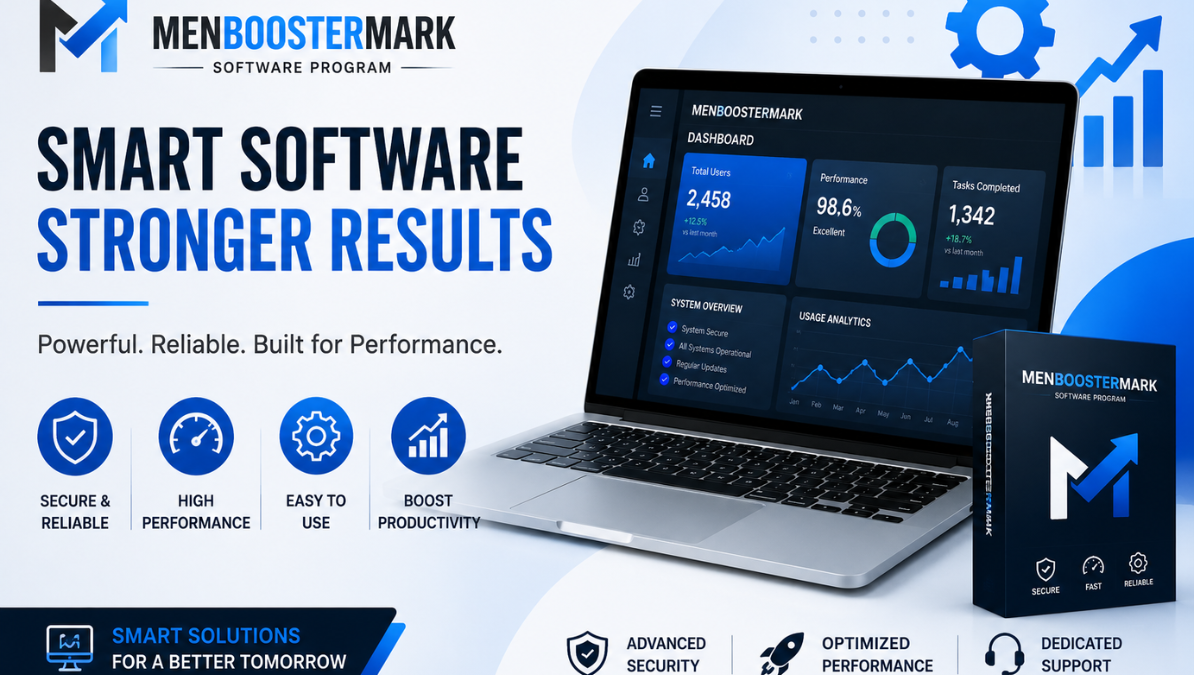
Explore this complete guide to the MenBoosterMark software program. Learn about platform architecture, performance benchmarking, automated marketing workflows, analytics, security compliance, and step-by-step implementation strategies.
Introduction: Why MenBoosterMark Software Matters in Modern Digital Management
In an era defined by data fragmentation, rising acquisition costs, and hyper-competitive digital markets, business leaders and performance marketers require tools that go beyond basic analytics. The MenBoosterMark software program has emerged as a specialized platform designed to unify performance tracking, audience benchmarking, workflow automation, and revenue optimization within a single cohesive system.
Whether managing direct-to-consumer (D2C) brands, digital health offerings, performance marketing networks, or subscription platforms, managing separate tools for analytics, attribution, customer retention, and workflow triggers creates friction. Data silos lead to missed opportunities, delayed campaign optimizations, and inflated Customer Acquisition Costs (CAC).
MenBoosterMark addresses this challenge by combining real-time metric tracking with dynamic benchmarking engines and automated action triggers. By standardizing how growth benchmarks (“Marks”) are measured and acted upon, the software empowers organizations to make data-driven decisions at scale. This guide provides an in-depth analysis of MenBoosterMark’s capabilities, technical framework, user workflows, security standards, and real-world implementation strategies.
Understanding MenBoosterMark Software & Target Demographics
What is MenBoosterMark Software?
MenBoosterMark is an enterprise-grade performance management and marketing optimization software program. Built to act as both a central intelligence hub and an automated action engine, the platform processes incoming customer and campaign data, evaluates it against custom or global benchmarks (termed “Booster Marks”), and triggers automated optimizations across integrated digital channels.
Unlike static dashboard software, MenBoosterMark operates on a proactive logic layer. When performance drops below a specified benchmark or spikes unexpectedly, the system doesn’t merely alert team members—it can execute real-time workflow adjustments, budget reallocations, and personalized messaging sequences.
+-----------------------------------------------------------------------+
|                    MenBoosterMark Core Engine                         |
+-----------------------------------------------------------------------+
|  [ Data Ingestion ] ---> [ Benchmark Analysis ] ---> [ Action Engine ]|
|  (Ad Networks, CRMs)     (Mark Index Calculation)    (Automations)    |
+-----------------------------------------------------------------------+
Primary Target Audience Demographics
The software is engineered for teams and professionals who handle high-volume digital transactions and complex customer lifecycles:
- E-Commerce & D2C Brand Managers: Teams scaling product lines that require precise tracking of Average Order Value (AOV), Repeat Purchase Rate, and Customer Lifetime Value (LTV).
- Performance Marketers & Media Buyers: Agencies and independent buyers managing multi-channel ad spend (Meta, Google, Native, Programmatic) who need unified multi-touch attribution.
- Affiliate Network Operators: Managers running performance networks who need robust fraud prevention, real-time Earnings Per Click (EPC) calculation, and automated payout rules.
- SaaS & Subscription Platforms: Operators aiming to reduce customer churn through automated behavioral triggers and predictive customer health scores.
Core System Architecture & Engine
To handle high-throughput event processing without latency, MenBoosterMark utilizes a cloud-native, microservices-based architecture designed for 99.99% uptime and high concurrency.
                  +-----------------------------------+
                  |        Client Interfaces          |
                  |  (Web Dashboard / Mobile / API)   |
                  +-----------------+-----------------+
                                    |
                                    v
                  +-----------------+-----------------+
                  |       API Gateway / Auth          |
                  |     (OAuth 2.0 / Rate Limit)      |
                  +-----------------+-----------------+
                                    |
          +-------------------------+-------------------------+
          |                                                   |
          v                                                   v
+-------------------+                               +-------------------+
| Benchmark Service |                               | Event Stream Engine|
| (Mark Calculator) |                               | (Kafka / Redis)   |
+---------+---------+                               +---------+---------+
          |                                                   |
          +-------------------------+-------------------------+
                                    |
                                    v
                  +-----------------+-----------------+
                  |    Database Layer (PostgreSQL)    |
                  |  (Multi-tenant Data Isolation)    |
                  +-----------------------------------+
Key Architectural Layers
1. Ingestion Layer & Event Streaming
The ingestion layer utilizes distributed messaging queues (e.g., Apache Kafka / Redis Streams) capable of ingesting tens of thousands of server-side webhooks and API events per second. This ensures that high traffic spikes—such as Black Friday sales or viral marketing campaigns—do not cause data drops or processing delays.
2. The Benchmark Analysis Engine
At the heart of the system is the Mark Engine, a proprietary evaluation pipeline that calculates historical, real-time, and predictive benchmarks. Incoming event streams are evaluated against baseline parameters within milliseconds, feeding raw inputs into the decision layer.
3. Database Architecture & Multi-Tenancy
MenBoosterMark employs a hybrid database strategy:
- Relational Storage (PostgreSQL): Handles structured data, including user accounts, billing records, campaign structures, and relational configurations.
- Time-Series & Document Storage (ClickHouse / MongoDB): Stores granular event logs, user clickstream data, and time-stamped metric histories to power instant analytical querying without slowing down relational operations.
- Tenant Isolation: Logical tenant isolation ensures that brand data remains separated, encrypted, and isolated across shared database clusters.
Essential Features and Functional Capabilities
MenBoosterMark packages complex data science into intuitive tools. Below are the five primary core modules:
+-----------------------------------------------------------------+
|               MenBoosterMark Core Feature Suite                 |
+-----------------------------------------------------------------+
| [1] Benchmark "Mark" Index   | [2] Multi-Touch Attribution     |
| [3] Automated Funnel Engine  | [4] Fraud & Quality Shield       |
| [5] Dynamic Offer Engine     |                                  |
+-----------------------------------------------------------------+
1. Dynamic Benchmark Indexing (“The Mark Engine”)
Rather than relying solely on fixed targets (e.g., “Maintain a $30 CAC”), MenBoosterMark continuously calculates rolling average benchmarks based on market trends, historical account data, and seasonal variances. Users can establish custom “Mark Scores” (scaled 1–100) that give an instant, single-metric representation of overall campaign health.
2. Multi-Touch Attribution (MTA)
The software supports several attribution models to eliminate blind spots caused by browser privacy restrictions (such as iOS ITP):
- First-Touch & Last-Touch: Traditional models for linear conversion mapping.
- Position-Based (U-Shaped / W-Shaped): Assigns higher weight to key discovery and conversion touchpoints.
- Algorithmic / Data-Driven Attribution: Uses machine learning models to analyze thousands of conversion paths and attribute revenue based on true path contribution.
3. Automated Funnel Optimization (AFO)
Through AFO, users set rules that automate routine marketing interventions. For example, if a specific ad creative’s Return on Ad Spend (ROAS) falls 20% below the campaign’s historical Mark Index over a 48-hour period, MenBoosterMark can automatically lower the ad set budget or pause the underperforming creative via direct ad network API integrations.
4. Fraud & Traffic Quality Shield
For brands utilizing affiliate marketing or third-party traffic networks, fraud can severely skew analytics and waste budgets. MenBoosterMark integrates real-time IP filtering, bot detection, click-frequency analysis, and proxy identification to filter out non-human or suspicious traffic before it registers in conversion funnels.
5. Dynamic Offer & Content Personalization
MenBoosterMark allows marketers to dynamically adjust on-page content, pricing tiers, and post-purchase upsells based on the incoming user’s profile, traffic source, and predicted lifetime value.
Data Analytics, Benchmarking, and Reporting Metrics
Data without context creates confusion. MenBoosterMark turns raw raw transaction streams into structured insights via custom dashboards, scheduled reports, and visual benchmarks.
Core Metrics Tracked & Calculated
| Metric | Calculation Formula | Benchmark Role in MenBoosterMark |
| Mark Index Score | Weighted average of ROAS, Conversion Rate, and Retention | Primary high-level metric for overall account health |
| Earnings Per Click (EPC) | $\text{Total Revenue} / \text{Total Clicks}$ | Evaluates traffic source profitability in real time |
| Customer Acquisition Cost (CAC) | $\text{Total Spend} / \text{New Customers Acquired}$ | Trigger point for automated budget adjustments |
| Return on Ad Spend (ROAS) | $(\text{Gross Revenue from Ads} / \text{Ad Spend}) \times 100$ | Core performance metric for paid media campaigns |
| Customer Lifetime Value (LTV) | $\text{ARPU} \times \text{Average Customer Retention Lifespan}$ | Guides long-term bidding strategies and retention efforts |
Visualizing Dashboards & Custom Alerts
MenBoosterMark provides customizable drag-and-drop widget layouts. Users can configure alert channels—including Slack, Microsoft Teams, Email, and SMS—to receive instant notifications whenever a metric crosses a critical threshold.
Key Rule for Alerting: To avoid notification fatigue, configure alerts using moving averages (e.g., 6-hour or 24-hour windows) rather than single isolated conversion events.
Automated Workflows and Integration Ecosystem
A major operational benefit of MenBoosterMark is its ability to communicate seamlessly across an organization’s existing software stack.
+-------------------------------------------------------------------------+
|                  MenBoosterMark Integration Hub                         |
+-------------------------------------------------------------------------+
| [Ad Platforms]  <--->  [MenBoosterMark]  <--->  [CRMs & ESPs]           |
| Meta, Google,          Core Automation          HubSpot, Salesforce,    |
| TikTok Ads             Engine                   Klaviyo, ActiveCampaign |
+-------------------------------------------------------------------------+
                                 |
                                 v
                     [Payment Gateways / ERPs]
                     Stripe, Shopify, Marg ERP
Integration Protocols
- RESTful API & GraphQL: Full platform functionality is exposed via clean REST endpoints and a GraphQL query interface for custom database queries.
- Webhooks Engine: Outbound webhooks stream real-time events to external endpoints whenever specific Mark Index benchmarks are hit.
- Pre-Built Connectors: Turnkey integrations exist for popular tools like Shopify, Meta Ads, Google Ads, HubSpot, Klaviyo, Stripe, and Marg ERP.
Example: Webhook Payload for Automated Campaign Pausing
When a campaign breaches safety parameters, MenBoosterMark dispatches a JSON payload to connected ad management tools:
JSON
{
  "event_type": "benchmark_breach",
  "timestamp": "2026-08-14T01:30:00Z",
  "account_id": "acc_mbm_88492",
  "data": {
    "campaign_id": "cmp_meta_90124",
    "campaign_name": "Summer Performance Top-of-Funnel",
    "metric_evaluated": "ROAS_24h",
    "target_benchmark": 1.85,
    "actual_value": 1.12,
    "mark_score": 38,
    "action_triggered": "PAUSE_CAMPAIGN"
  }
}
User Interface (UI), Experience (UX), & Navigation
MenBoosterMark balances enterprise functionality with user-centered UI/UX design, focusing on speed and scannability.
+-------------------------------------------------------------------+
|                     MenBoosterMark Workspace                      |
+-------------------------------------------------------------------+
|  [Global Search / Tenant Switcher]            [User Profile / API]|
+-------------------------------------------------------------------+
| (Sidebar)    | [Main Dashboard View]                              |
| - Overview   | +------------------------------------------------+ |
| - Marks      | | Mark Index: 84/100 (HEALTHY)                   | |
| - Campaigns  | +------------------------------------------------+ |
| - Automation | | ROAS: 2.45x  | EPC: $1.82  | CAC: $24.10        | |
| - Settings   | +------------------------------------------------+ |
|              | | Live Event Stream & Alert Feed                 | |
+--------------+----------------------------------------------------+
Workspace Navigation Structure
- Global Navigation Bar: Houses tenant/brand selection, search, user permissions, and master system settings.
- Sidebar Menu: Organized logically into five main management zones:
- Overview / Command Center: High-level executive summaries and aggregate Mark Scores.
- Benchmark Studio: Where custom benchmark algorithms, rules, and scoring scales are built and tuned.
- Campaign Manager: Deep-dive multi-channel tracking, channel breakdowns, and attribution modeling.
- Automation Builder: Drag-and-drop flowchart builder for creating conditional logic sequences.
- Integrations & API: Webhook management, API key generation, and app marketplace connectivity.
Role-Based Access Control (RBAC)
To protect sensitive financial and customer data, MenBoosterMark enforces granular permission levels:
- Admin / Superuser: Complete system access, billing management, API key control, and user role provisioning.
- Media Buyer / Manager: Access to campaign tracking, automation creation, and performance reporting.
- Analyst (Read-Only): Access to view dashboards, generate exportable reports, and inspect metric trends without execution privileges.
- Affiliate / External Partner: Restricted access showing only partner-specific traffic, conversions, and estimated payouts.
Security, Compliance, and Data Governance
Operating in modern digital commerce environments requires strict adherence to security protocols and privacy legislation.
Key Security Standards
- Data Encryption: All data transmitted between clients, ad networks, and server nodes is encrypted using TLS 1.3 protocol. Data stored at rest in underlying databases uses AES-256 bit encryption.
- API Security: Authentication uses OAuth 2.0 and API keys wrapped in HMAC signatures to prevent unauthorized requests or data manipulation.
- Infrastructure: Hosted across multi-region, SOC-2 Type II certified cloud server architectures with automated DDoS mitigation layers.
Regulatory Compliance Frameworks
+--------------------------------------------------------------------+
|              MenBoosterMark Regulatory Compliance                  |
+--------------------------------------------------------------------+
| [GDPR] Anonymization, Consent Framework & Right-to-be-Forgotten    |
| [CCPA] Explicit Opt-out Capabilities & Consumer Data Controls      |
| [PCI-DSS Level 1] Tokenized Payment Gateway Security Standard      |
+--------------------------------------------------------------------+
- GDPR & CCPA Compliance: MenBoosterMark features native cookie-less server-side tracking mechanisms that respect user consent frameworks. First-party user data is hashed (SHA-256) prior to processing, preserving privacy while enabling attribution accuracy.
- PCI-DSS Standards: The software does not directly store credit card numbers. All billing transactions pass through tokenized payment gateways (such as Stripe or Merchant Processors) complying with PCI-DSS Level 1 standards.
Practical Real-World Use Cases
To highlight the versatility of MenBoosterMark software, consider three detailed real-world applications across distinct business verticals.
Case Study 1: Direct-to-Consumer (D2C) Supplement Brand
- Challenge: A fast-growing D2C wellness brand experienced volatile ROAS due to rising ad costs and inaccurate last-click tracking on mobile devices.
- Solution: The brand implemented MenBoosterMark’s Multi-Touch Attribution and dynamic “Mark Index” scoring.
- Execution:
- Connected Shopify and Meta/Google ad accounts via server-side API webhooks.
- Established a benchmark rule: If 3-day cohort LTV predicted a CAC payback period greater than 45 days, reduce campaign budget by 15%.
- Automated post-purchase email triggers based on predicted customer repurchase windows.
- Outcome: Reduced blended CAC by 22% within 60 days while increasing 90-day repeat order revenue by 34%.
Case Study 2: Performance Marketing Network Management
- Challenge: An affiliate network needed to evaluate traffic quality across 150+ publisher channels while protecting against click fraud and low-converting traffic.
- Solution: Deployed MenBoosterMark as the master traffic routing and fraud filtering shield.
- Execution:
- Routed all incoming publisher traffic through MenBoosterMark’s real-time Fraud Shield.
- Configured automated routing rules based on Earnings Per Click (EPC): High-EPC traffic was dynamically routed to premium landing pages, while low-EPC traffic was redirected to secondary offers.
- Outcome: Eliminated 14% of invalid traffic before spending budget, boosting net network margins by 18%.
Case Study 3: SaaS Subscription Model Churn Reduction
- Challenge: A digital fitness software subscription platform was suffering from a 7% monthly subscriber churn rate.
- Solution: Utilized MenBoosterMark’s behavioral tracking and automated retention workflows.
- Execution:
- Created a “Subscriber Health Mark” score based on weekly app logins, feature usage, and support ticket submissions.
- Automated an intervention sequence: If a user’s Health Mark dropped below 40 points, an in-app prompt and re-engagement campaign were automatically dispatched.
- Outcome: Reduced monthly subscriber churn from 7% down to 4.2% over a four-month period.
Comparative Analysis: MenBoosterMark vs. Traditional Solutions
Selecting software requires understanding how MenBoosterMark compares against standard analytical and marketing management platforms.
| Feature / Capability | MenBoosterMark Software | Traditional Analytics (e.g., GA4) | Standard Campaign Management Tools |
| Primary Focus | Proactive automation & benchmark scoring | Passive historical reporting | Channel-specific campaign execution |
| Attribution Model | Multi-touch, server-side data-driven | Sampled event-based last-click | Single-channel last-touch |
| Proactive Automation | Native rules engine with cross-platform actions | None (reporting only) | Basic channel-level budget adjustments |
| Fraud & Quality Shield | Native real-time IP & bot filtering | Basic referral exclusions | Requires third-party add-ons |
| Setup & Integration | Webhook & API native (Low-code) | Script tag implementation | Deep single-channel integrations |
| Cross-Channel Unification | Complete (Ads, CRM, ERP, Affiliates) | Partial / Requires custom BigQuery | Limited to supported ad networks |
Key Takeaway from Comparison
While platforms like Google Analytics excel at broad traffic visualization and ad management tools excel at single-channel optimization, MenBoosterMark bridges the gap by combining cross-channel analytics with real-time automated execution based on unified benchmarks.
Step-by-Step Implementation Roadmap & Best Practices
Successfully deploying MenBoosterMark requires a structured rollout strategy to ensure data integrity, team alignment, and maximum ROI.
+-----------------------------------------------------------------+
|               4-Phase Implementation Roadmap                    |
+-----------------------------------------------------------------+
| Phase 1: Onboarding & API Connection (Days 1–7)                 |
| Phase 2: Baseline Benchmark Configuration (Days 8–14)           |
| Phase 3: Automation Building & Testing (Days 15–21)             |
| Phase 4: Full Deployment & Continuous Optimization (Days 22+)   |
+-----------------------------------------------------------------+
Phase 1: Onboarding & API Connection (Days 1–7)
- Account Provisioning: Set up organization settings, assign administrator roles, and configure multi-tenant brand structures.
- Tracking Protocol Installation: Deploy server-side API webhooks and lightweight client-side scripts across landing pages, checkout funnels, and app endpoints.
- Third-Party Integration Connection: Authenticate ad network APIs (Meta, Google, TikTok), CRM tools, and payment gateways.
Phase 2: Baseline Benchmark Configuration (Days 8–14)
- Historical Data Sync: Import 60–90 days of historical campaign and financial data to populate baseline metrics.
- Define Mark Index Parameters: Set custom weightings for CAC, ROAS, EPC, and retention rates to calculate accurate baseline Mark Scores.
- Data Auditing: Compare tracking events across MenBoosterMark, internal database logs, and merchant payment systems to verify 99%+ attribution accuracy.
Phase 3: Automation Building & Testing (Days 15–21)
- Configure Safety Guardrails: Create conservative automated rules (e.g., alert teams when ROAS drops rather than immediately pausing budgets).
- Dry-Run Testing: Simulate threshold breaches in a staging environment to ensure webhook payloads fire accurately without disrupting operational systems.
- Team Onboarding: Conduct role-specific training for media buyers, analysts, and account managers.
Phase 4: Full Deployment & Continuous Optimization (Days 22+)
- Activate Live Execution Engine: Enable automated campaign adjustments, budget reallocations, and dynamic routing logic.
- Weekly Benchmark Calibration: Review performance trends every 7–14 days and recalibrate Mark Index scoring parameters to match shifting market conditions.
- Scale Expansion: Integrate secondary acquisition channels and advanced audience segmentation rules.
Common Pitfalls to Avoid
- Over-Automating Too Early: Do not enable aggressive budget-cutting or campaign-pausing rules during your first week. Allow the system to collect sufficient historical data to avoid premature interventions.
- Ignoring Multi-Touch Data: Relying exclusively on single-touch attribution within MenBoosterMark defeats the platform’s multi-touch analysis capabilities. Evaluate campaigns using data-driven models for top-of-funnel channels.
- Uncalibrated Alert Thresholds: Setting metric alerts too tight leads to notification fatigue. Ensure alerts reflect statistically significant performance deviations over sustained time windows.
Conclusion: Summary and Strategic Outlook
The MenBoosterMark software program represents a shift from passive data monitoring to proactive business management. By consolidating multi-channel tracking, automated campaign interventions, fraud mitigation, and real-time benchmark evaluation into a single ecosystem, the platform addresses the speed and precision demanded by modern digital markets.
For organizations scaling performance marketing, e-commerce stores, or subscription services, implementing a unified benchmarking tool like MenBoosterMark reduces manual reporting overhead, protects marketing margins, and drives consistent, predictable growth. When backed by a structured implementation roadmap and disciplined team execution, MenBoosterMark delivers a distinct competitive advantage in data-driven operations.
